
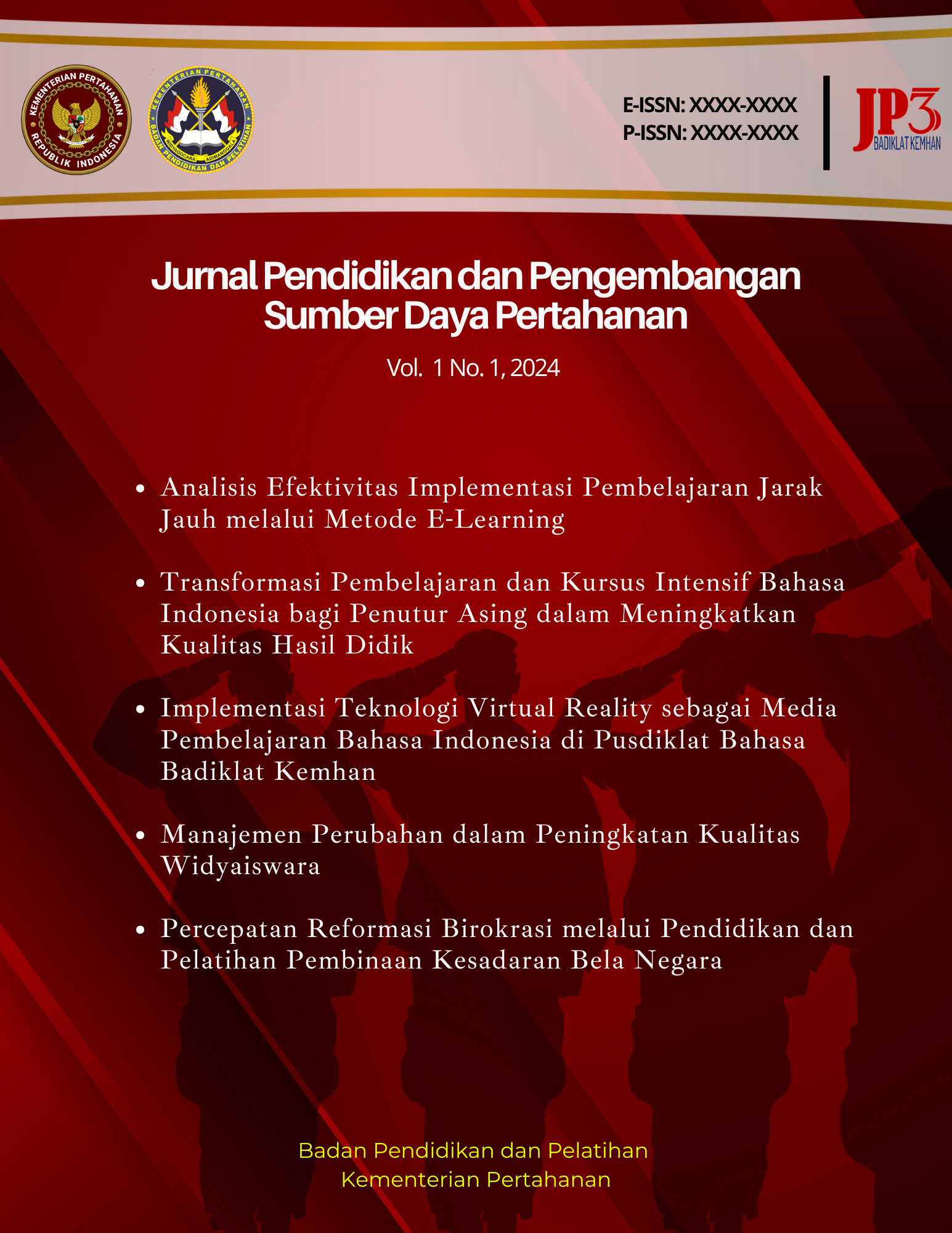
Change Management in Improving The Quality of Widyaiswara
DOI:
https://doi.org/10.63210/jp3.v1i1.11Keywords:
Change Management, Competence, Work QualityAbstract
This research departs from the problem of the low willingness of the Pusdiklat Bela Negara to change to improve its quality. Their performance demands are to produce students who have an understanding of defending the country and can actualize it and socialize it with others. The argument built in this study is that the quality of widyaiswara in the state defense education and training center has not improved because there is no change in work culture. Thus, the proposition built in this study is, "Change management is a supporting factor in improving the quality/competence of widyaiswara". The formulation of this research problem is the effort of the State Defense Education and Training Center in improving the quality of widyaiswara? The purpose of this research is to describe and analyze the efforts made by the State Defense Education and Training Center to improve the quality of widyaiswara. The theory used in this study is the theory of change from Kurt Lewin in Chaerudin (2019: 75). Lewin described the change as occurring in 3 (three) stages, namely: unfreezing, moving, and refreezing. The research method used is qualitative descriptive. The data collection method is carried out through in-depth interviews, observations, documentation studies, and literature studies to collect supporting literature. The findings in this study are that leadership encouragement and organizational support are supporting factors in making changes. The conclusion of this research is to improve the quality of widyaiswara, carried out through change management, starting from the stages of unfreezing, moving, and refreezing, and this is a necessity for the existence of an organization to keep up with changes in its environment and the demands of the external environment
References
Baidowi, Achmad. (2022). Manajemen Perubahan Pendidikan. Journal of Educational Management, VOLUME 3 NOMOR 1. DOI: https://doi.org/10.37411/jjem.v3i1.1278.
Chaerudin, A. (2019). Manajemen Pendidikan dan Pelatihan SDM. Sukabumi: CV Jejak.
Cummings, S., Bridgman, T., & Brown, K. G. (2016). Unfreezing change as three steps: Rethinking Kurt Lewin’s legacy for change management. Human Relations, 69(1), 33–60. https://doi.org/10.1177/0018726715577707.
Desy, P. (2020). Modul Manajemen Perubahan Dan Pengembangan (Ebm 513). Universitas Esa Unggul.
Dewi, R.R & Kurniawan, T. (2019). Manajemen Perubahan Organisasi Publik: Mengatasi Resistensi Perubahan. Jurnal Natapraja: Kajian Ilmu Administrasi Negara. Vol 7, No 1. DOI: https://doi.org/10.21831/jnp.v7i1.24599.
Dzakiyyah, H.N. (2022) Program Pengembangan Manajemen Diklat Terhadap Peningkatan Kualitas Guru di Era Society 5.0. Jurnal Pendidikan Islam dan Manajemen Pendidikan Islam Andragogi, Vol 4, No 01.
Harifin, M., Priamarizki, A., Marzuki, Dkk. (2018). The Army and Ideology in Indonesia: from Dwifungsi to Bela Negara. DOI: 10.4324/9781003092926.
Indarti, L., Nurdin, D. (2022) Peningkatan Kompetensi Guru Melalui Diklat Daring Masif Dan Terbuka (Didamba) Pada Mata Diklat English for Teaching Science Yang Diselenggarakan Oleh PPPPK IPA. Jurnal Pengabdian Masyarakat Multidisiplin. Vol 6 No 1. https://doi.org/10.36341/jpm.v6i1.2681.
Malayu, S. P. H. (2003). Manajemen Sumber Daya Manusia. (Edisi Revisi Cetakan ke-8). Jakarta: PT. Bumi Aksara.
Mellita, D., & Elpanso, E. (2020). Model Lewin Dalam Manajemen Perubahan Teori Klasik Menghadapi Disrupsi Dalam Lingkungan Bisnis. Mbia, 19(2), 142–152. https://doi.org/10.33557/mbia.v19i2.989.
Munandar, D.R. (2021). Manajemen Perubahan Organisasi Sekolah Luar Biasa. Jurnal Wahana Karya Ilmiah Pendidikan, Vol. 5 No. 02. https://journal.unsika.ac.id/index.php/pendidikan/article/view/1768.
Nugraha, F. (2020). Pendidikan dan Pelatihan, Konsep dan Implementasi dalam Pengembangan Sumber Daya Manusia. Jakarta: Litbangdiklat Press.
Nurjanah, Ai. (2019). Evaluasi Diklat Peningkatan Kompetensi Penilaian Kinerja Guru (PKG) dan Pengembangan Keprofesionalan Berkelanjutan (PKB). EDUKASI: Jurnal Penelitian Pendidikan Agama dan Keagamaan, 17(3), 284-299. Website: http://jurnaledukasikemenag.org.
Notoatmodjo, S. (2003). Pengembangan Sumber Daya Manusia. Jakarta: Rineka Cipta.
Sarayreh, B., Khudair, H., & Barakat, E. A. (2013). Comparative Study: The Kurt Lewin of Change Management. International Journal of Computer and Information Technology, 02(04), 626–629. http://ijcit.com/archives/volume2/issue4/Paper020413.pdf.
Schein, E. H. (1996). Kurt Lewin’s change theory in the field and in the classroom: Notes toward a model of managed learning. Systems Practice, 9(1), 27–47. https://doi.org/10.1007/BF02173 417.
Septiawan, E., Herdiansyah, A.G., Dermawan, W. (2018). The enactment of state defense awareness with the synergy conception among military, government, and civil society: Study in Adi Soemarmo Air Base, Surakarta, Indonesia. Central European Journal of International and Security StudiesVolume 12, Issue 4, Pages 96 – 110. DOI: https://doi.org/10.36671/andragogi.v4i01.254.
Setiadi, T., Murtado, D., Hendarsah, H. (2023) Manajemen Diklat untuk Meningkatkan Kompetensi Guru PPPK Di Kota Tasikmalaya. Jurnal Wahana Pendidikan, Vol 10, No 1. DOI: http://dx.doi.org/10.25157/jwp.v10i1.9589.
Siregar, E. (2018). Faktor-Faktor Yang Mempengaruhi Manajemen Pendidikan dan Pelatihan (Diklat) Dalam Upaya Pengembangan Sumber Daya Manusia (SDM). Jurnal Dinamika Pendidikan, Volume 11, No 2. 153-166.
Shirey, M. R. (2013). Lewin’s theory of planned change as a strategic resource. Journal of Nursing Administration, 43(2), 69–72. https://doi.org/10.1097/NNA.0b 013e31827f20a9.
Widorekno, R.A., Supriyadi. (2021) Implementasi Nilai-Nilai Bela Negara dalam Menghadapi Ancaman Non Militer (Covid-19). Jurnal Ilmu Pengetahuan Nasional (Nusantara), Vol 8, No 4. DOI: http://dx.doi.org/10.31604/jips.v8i4.2021.786-792.
Widyaningrum, B., Nurdianti, R.R.S., Kurniawan. (2022). Teori Manajemen Perubahan Kurt Lewin: Kajian dalam Menghadapi Disrupsi Pendidikan Post-Covid 19. http://jurnal.untidar.ac.id.
Downloads
Published
How to Cite
Issue
Section
License
Copyright (c) 2024 ministry of defense education and training agency

This work is licensed under a Creative Commons Attribution-NonCommercial-ShareAlike 4.0 International License.
All articles published in this journal are licensed under a Creative Commons Attribution 4.0 International License (CC BY 4.0) .
This license allows users to share (copy and redistribute the material in any medium or format) and adapt (remix, transform, and build upon the material) for any purpose, even commercially, provided that appropriate credit is given to the original author(s) and the source.
Copyright of all articles is held by Badan Pendidikan dan Pelatihan Kementerian Pertahanan Republik Indonesia.
For articles published prior to 2026, licensing and copyright information may differ as stated in the article files.




