
The Strategic Role of Defense Education in Strengthening Indonesia's National Security System
DOI:
https://doi.org/10.63210/jp3.v2i1.138Keywords:
Keywords: defense education, national security system, national defense awareness, national resilience, defense strategyAbstract
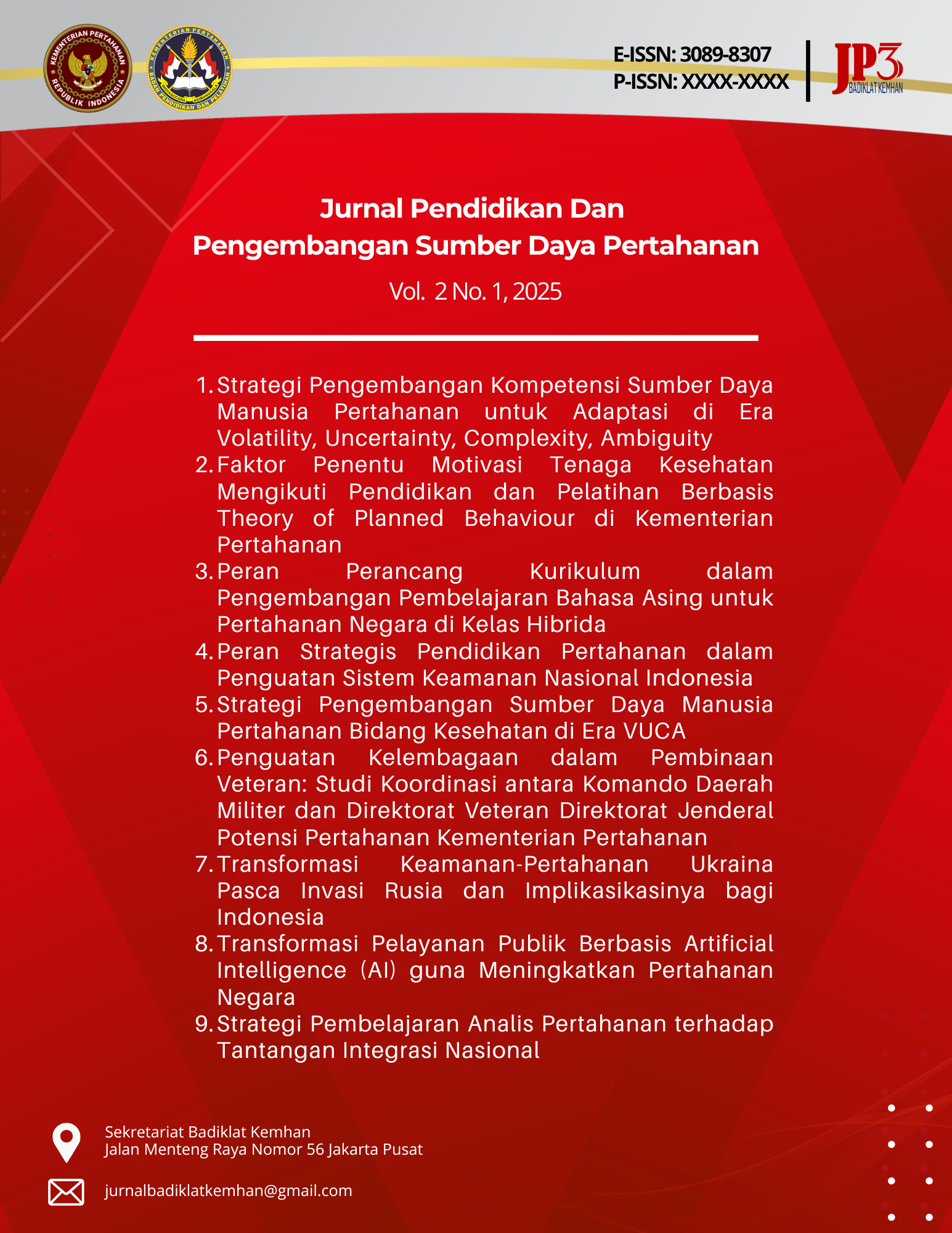
Defense education plays a strategic role in shaping a strong national defense posture that is responsive to military and non-military threats. This article examines the vital role of defense education in strengthening Indonesia's national security system amidst the ever-evolving global and regional dynamics. Using a qualitative descriptive approach, this study highlights the contribution of defense education in increasing national defense awareness, strengthening national identity, and fostering synergy between civilian and military components within the framework of national resilience. In the era of information disruption and multidimensional threats, defense education is the main foundation for building collective community awareness against ideological infiltration, foreign propaganda, and increasingly complex cyber threats. The research findings show that defense education integrated into the national education system functions as a strategic instrument to instill national values, patriotism, and national preparedness from an early age. Therefore, optimizing the curriculum, improving the quality of training, and expanding the scope of defense education programs are the main keys to building an adaptive and sustainable national security ecosystem. In addition, the importance of innovation in teaching methods, utilization of digital technology, and active involvement of civil society are supporting factors in expanding the reach and effectiveness of defense education. This study concludes that defense education is not merely an institutional need, but rather a long-term strategic investment for Indonesia's stability, sovereignty, and national resilience in the future.
References
Badan Pembinaan Ideologi Pancasila. (2020). Modul pendidikan Pancasila dan bela negara. Jakarta: BPIP.
Creswell, J. W. (2014). Research design: Qualitative, quantitative, and mixed methods approaches (4th ed.). Thousand Oaks, CA: Sage Publications.
Departemen Pertahanan Republik Indonesia. (2022). Rencana Strategis Kementerian Pertahanan 2020–2024. Jakarta: Kemenhan RI.
Indrayana, D. (2021). Pertahanan negara dalam sistem hukum Indonesia. Jakarta: Rajawali Pers.
Kementerian Pertahanan Republik Indonesia. (2022). Grand Design Bela Negara Tahun 2020–2024. Jakarta: Kemenhan RI.
Kurniawan, A. (2020). Strategi penguatan pendidikan bela negara dalam menghadapi ancaman nonmiliter di era digital. Jurnal Pertahanan dan Bela Negara, 10(2), 225–240. https://doi.org/10.33172/jpbn.v10i2.555
Miles, M. B., Huberman, A. M., & Saldaña, J. (2014). Qualitative data analysis: A methods sourcebook (3rd ed.). Thousand Oaks, CA: Sage Publications.
Nugroho, R. (2020). Public policy: Dinamika kebijakan, analisis kebijakan, manajemen kebijakan. Jakarta: Elex Media Komputindo.
Peraturan Presiden Republik Indonesia Nomor 8 Tahun 2021 tentang Kebijakan Umum Pertahanan Negara Tahun 2020–2024.
Rahmadani, A., & Siregar, R. (2021). Pendidikan bela negara sebagai upaya preventif menghadapi radikalisme digital. Jurnal Ketahanan Nasional, 27(1), 89–102. https://doi.org/10.22146/jkn.v27i1.61245
Sugiyono. (2017). Metode penelitian kualitatif, kuantitatif, dan R&D. Bandung: Alfabeta.
Undang-Undang Republik Indonesia Nomor 3 Tahun 2002 tentang Pertahanan Negara.
United Nations Development Programme (UNDP). (1994). Human development report 1994: New dimensions of human security. New York: Oxford University Press.
Wibowo, R. (2020). Peran pendidikan bela negara dalam memperkuat identitas nasional generasi muda. Jurnal Pendidikan Kewarganegaraan, 10(1), 15–29.
Yani, Y. M. (2022). Sistem pertahanan semesta sebagai strategi pertahanan negara Indonesia: Kajian konseptual dan implementasi. Jurnal Strategi Pertahanan, 8(3), 305–321
Downloads
Published
How to Cite
Issue
Section
License
Copyright (c) 2025 ministry of defense education and training agency

This work is licensed under a Creative Commons Attribution-NonCommercial-ShareAlike 4.0 International License.
All articles published in this journal are licensed under a Creative Commons Attribution 4.0 International License (CC BY 4.0) .
This license allows users to share (copy and redistribute the material in any medium or format) and adapt (remix, transform, and build upon the material) for any purpose, even commercially, provided that appropriate credit is given to the original author(s) and the source.
Copyright of all articles is held by Badan Pendidikan dan Pelatihan Kementerian Pertahanan Republik Indonesia.
For articles published prior to 2026, licensing and copyright information may differ as stated in the article files.




