
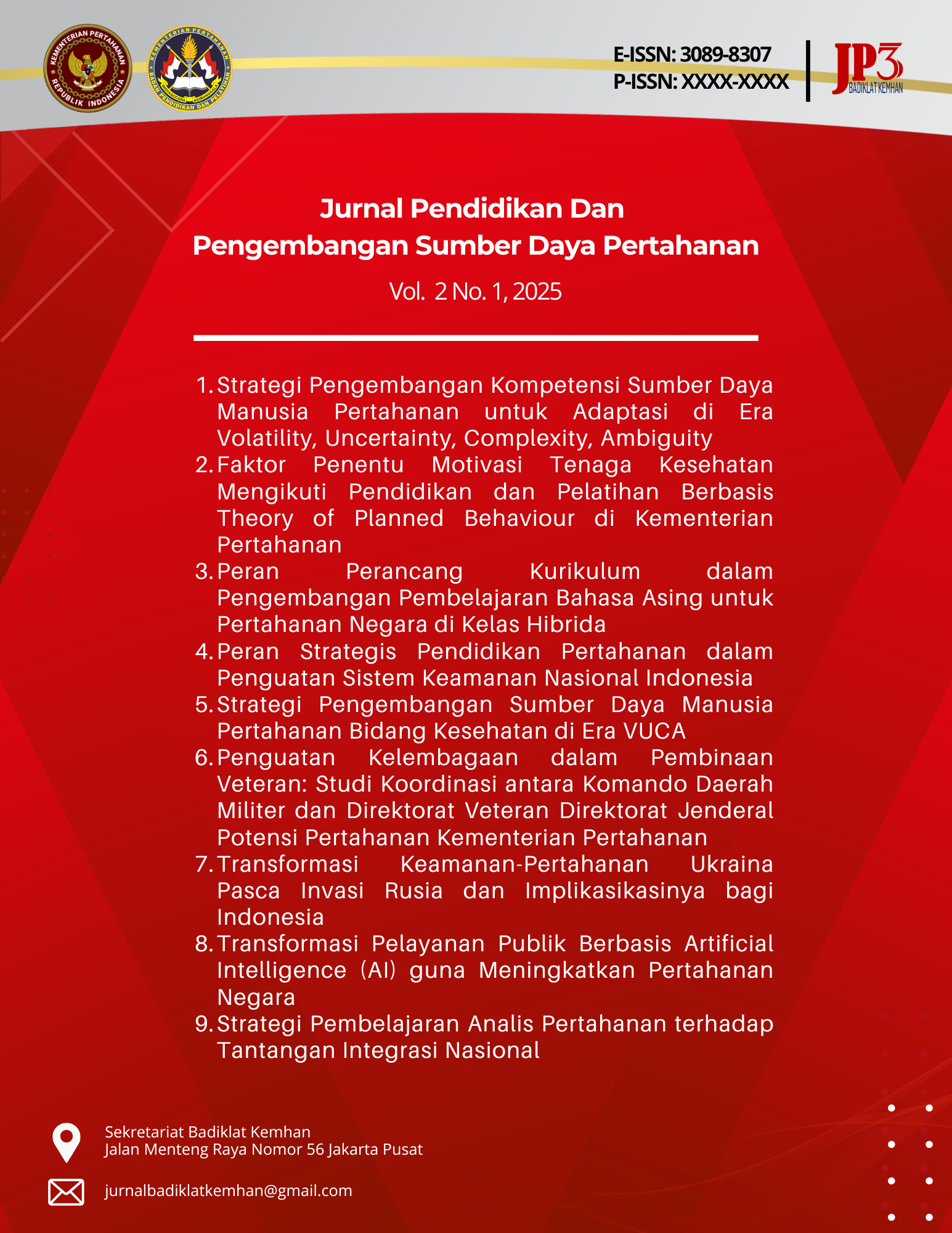
Strategies for Developing Competent Defense Human Resources for Health in the VUCA Era
DOI:
https://doi.org/10.63210/jp3.v2i1.145Keywords:
HR, defense, health, VUCA.Abstract
The world is currently facing major challenges in various aspects of life characterized by volatility, uncertainty, complexity and ambiguity, known as VUCA. This condition has a significant impact on various sectors, including the national defense sector. To answer these challenges, strengthening human resource (HR) management is very important, especially in preparing competent and adaptive human resources (HR) to disruption. One strategic area that requires special attention is the health sector, given the vital role of health workers in supporting national readiness and resilience. The purpose of this paper is to examine defense human resource development strategies in the health sector that are relevant and effective in facing the VUCA era. This study uses a literature study to find theories and practices related to HR development strategies in the VUCA era through online databases such as journals, books and articles. The results of the study show that there are four important dimensions that can be the foundation of HR development strategies, namely vision (clear vision), understanding (situational understanding), clarity (clarity of roles and goals), and agility (agility in adapting). Implementative strategies that can be carried out include education and training programs, the use of technology and innovation, improving the physical and mental hewell-being human resources for health, strengthening value-based leadership and ethics, and developing cross-sector collaboration and partnerships. These strategies can be concrete recommendations in supporting the development human resources for health as an integral part of a competent national defense system in the VUCA era.
Downloads
Published
How to Cite
Issue
Section
License
Copyright (c) 2025 ministry of defense education and training agency

This work is licensed under a Creative Commons Attribution-NonCommercial-ShareAlike 4.0 International License.
All articles published in this journal are licensed under a Creative Commons Attribution 4.0 International License (CC BY 4.0) .
This license allows users to share (copy and redistribute the material in any medium or format) and adapt (remix, transform, and build upon the material) for any purpose, even commercially, provided that appropriate credit is given to the original author(s) and the source.
Copyright of all articles is held by Badan Pendidikan dan Pelatihan Kementerian Pertahanan Republik Indonesia.
For articles published prior to 2026, licensing and copyright information may differ as stated in the article files.




