
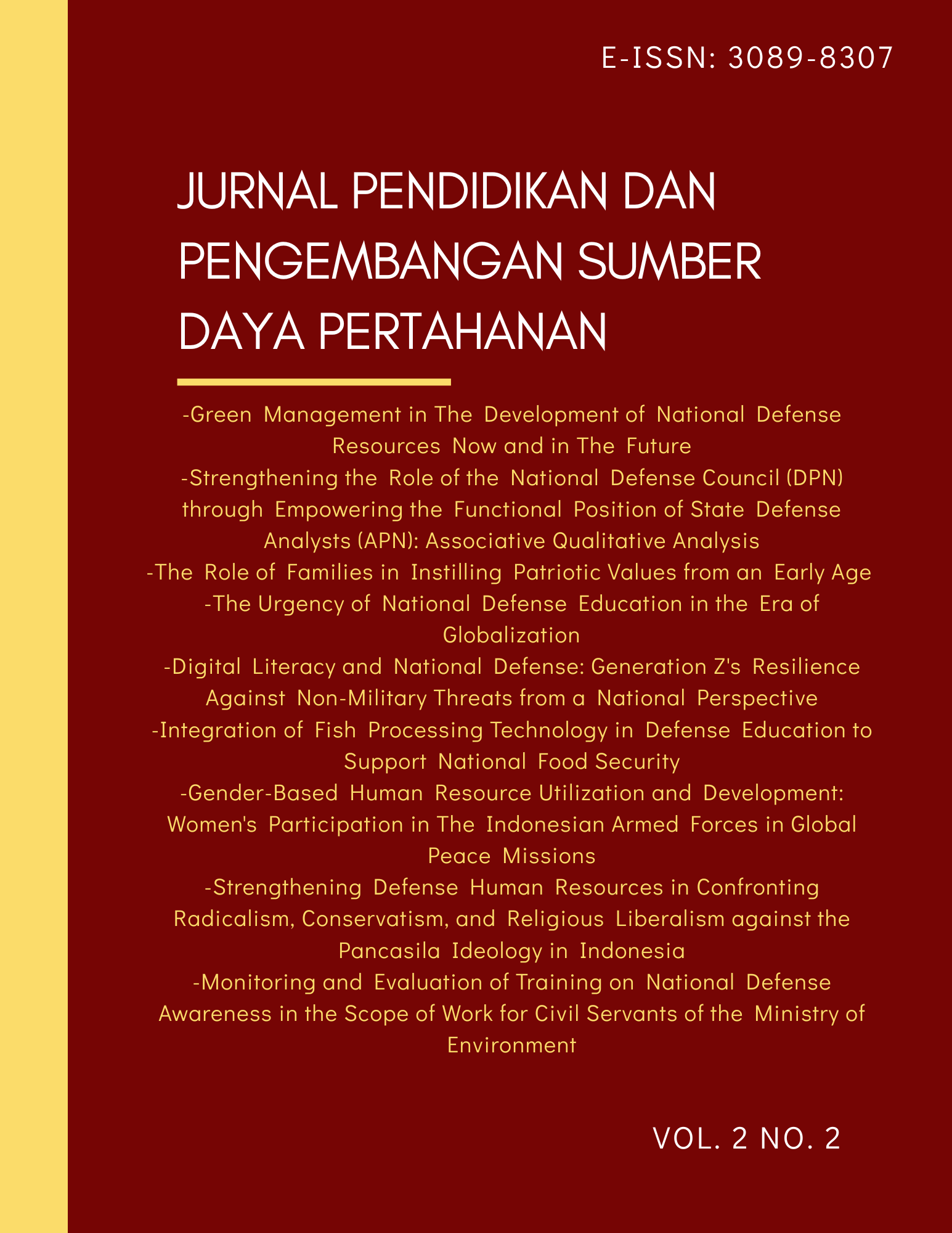
The Role of Families in Instilling Patriotic Values from an Early Age
DOI:
https://doi.org/10.63210/jp3.v2i2.158Keywords:
National Defence, Family Role, Character Building, Early ChildhoodAbstract
In the age of information disruption, our national standards faced very significant challenges. The unregulated dissemination of information frequently undermines national identity and can damage unity; thus, fostering national defense perspectives should commence at an early stage. This research contends that the family, as the smallest social unit for individuals, plays an important and essential role in cultivating national security knowledge and values from an early age. This research utilizes an extensive literature review methodology with a qualitative approach to systematically examine diverse library resources, including scientific journals, books, and prior research findings, via Google Scholar, Scopus, and DOAJ, covering publications from 2011 to 2025. Through the selection procedure, 25 appropriate research articles were found and thematically examined to identify trends in the development of national defense views within families. The study results consistently indicate that daily home activities, including discipline, ensuring cleanliness, orderliness, and fostering mutual cooperation, substantially and successfully nurture the foundation of patriotism and national defense awareness in children. These constructive habits progressively cultivate a child's character into a responsible individual who values the environment and possesses a sense of national identity. Literacy studies enable youngsters to comprehend the notion of national security not merely as doctrine, but as a fundamental aspect of communal existence. In conclusion, fostering patriotism from an early age is most effective and lasting when initiated within the home context, complemented with appropriate reading enrichment aligned with the child's developmental stage. This research provides practical recommendations for development, including daily activity guidelines, inspirational narratives, and national literacy modules aimed at assisting parents in imparting the significance of national defense at home. Consequently, we can cultivate a young generation that is not only innovative but also inspired with a feeling of responsibility, patriotism, and readiness to contribute constructively to the advancement of the nation.
References
Alhusna, F. N., & Masruroh, S. (2021). Model Perilaku Pencarian Informasi Dalam Memenuhi Kebutuhan Informasi: Kajian Literatur. IJAL (Indonesian Journal of Academic Librarianship), 5(1), 19-28. https://www.journals.apptisjatim.org/index.php/ijal/article/view/100
Alif, M., & Solihin, O. (2023). Kajian Tinjauan Literatur Dalam Penelitian Sosial. Jurnal Signal, 11(2), 277-297.
Anisah, A. S. (2011). Pola Asuh Orang Tua Dan Implikasinya Terhadap Pembentukan Karakter Anak. Jurnal Pendidikan UNIGA, 5(1), 70-84. https://doi.org/10.52434/jp.v5i1.43
Ansori, Y. Z. (2023). Peranan Orang Tua dalam Pembinaan Karakter bagi Anak Usia Dini. SANISKALA : Jurnal Pengabdian Masyarakat, 1(1),10–14. https://doi.org/10.31949/jsk.v1i1.6225
Cooter, R. D., & Siegel, N. S. (2010). Collective Action Federalism: A General Theory Of Article I, Section 8. Stan. L. Rev., 63, 115.
Hakiki, A., Anisa, A., & Salsabilla, P. A. N. (2024). Implementasi Pendidikan Bela Negara pada Jenjang Sekolah Dasar di Era Disrupsi Teknologi. Jurnal Pendidikan Guru Sekolah Dasar, 1(3), 10-10. https://doi.org/10.47134/pgsd.v1i3.508
Ignatiev, A., Burlakov, S., Terletskii, A., Skryl, S., & Shovkun, Y. (2025). Assessing Modern Challenges And Threats Affecting National Security By Full-Scale Military Operations. DIXI, 27(2), 1-14. https://doi.org/10.16925/2357-5891.2025.02.02
Indrianti, T. (2020). Peran Orang Tua Dalam Membentuk Karakter Anak Di Desa Kedaton Induk Kecamatan Batanghari Nuban Lampung Timur. (Doctoral dissertation, IAIN Metro).
Irvansyah, I., Widarto, J., Markoni, M., & Subiyanto, A. E. (2024). Analisis Peraturan Daerah Daerah Istimewa Yogyakarta Nomor 1 Tahun 2022 Tentang Pendidikan Pancasila Dan Wawasan Kebangsaan. Social Science Academic, 2(2), 231-250. https://doi.org/10.37680/ssa.v2i2.6098
Ismail, F. (2023). Optimization of the Total Defense System in Facing National Securities Challenges to Defend State Sovereignty. European Journal of Humanities and Social Sciences, 3(6), 49-54.
Krebs, R. R. (2004). A School For The Nation? How Military Service Does Not Build Nations, And How It Might. International Security, 28(4), 85-124.
Laborde, C. (2002). From Constitutional To Civic Patriotism. British journal of political science, 32(4), 591-612.
Lestari, Sri. (2016). Psikologi Keluarga. Jakarta: Prenada Media.
Lickona, T. (2013). Educating for Character: How Our Schools Can Teach Respect and Responsibility. New York: Bantam Books.
Mardhani, D., Runturambi, A. J. S., & Hanita, M. (2020). Security and Defense in National Resilience Studies to Realize A National Security System. Jurnal Pertahanan dan Bela Negara, 10(3), 267-286. https://doi.org/10.33172/jpbh.v10i3.1112
Murtiningsih, I. (2020). Peran Keluarga Dalam Menanamkan Sikap Bela Negara Pada Remaja. Civics Education And Social Science Journal (Cessj), 2(1). https://doi.org/10.32585/cessj.v2i1.769
Musthofa, A. (2019). Penguatan Nilai Kebangsaan pada Anak Usia Dini. Jurnal Golden Age, 3(1), 25–36.
Okditazeini, V., & Irwansyah, I. (2018). Ancaman Privasi Dan Data Mining Di Era Digital: Analisis Meta-Sintesis Pada Social Networking Sites (Sns). Jurnal Studi Komunikasi Dan Media, 22(2), 109-122.
Pemerintah Republik Indonesia. (1945). Undang-Undang Dasar Negara Republik Indonesia Tahun 1945.
Peraturan Menteri Pertahanan Republik Indonesia Nomor 8 Tahun 2022 tentang Pedoman Pembinaan Kesadaran Bela Negara. Jakarta: Direktorat Jenderal.
Peterson, A. (2011). Civic Virtue. In Civic Republicanism and Civic Education: The Education of Citizens (pp. 77-97). London: Palgrave Macmillan UK.
Pietrzak, P., & Laskowski, M. (2022). The Role Of The Family Environment In Strengthening Pro-Defensive Attitudes Of The 21st Century Society. Bezpieczeństwo. Teoria i Praktyka, 48(3), 391-403.
Priyadi, R., Diantoro, M., & Parno, P. (2018). Kajian Literatur: Model Mental Dan Metode Evaluasinya. Jurnal Pendidikan Sains (JPS), 6(2), 70-75. https://doi.org/10.26714/jps.6.2.2018.70-75
Ramírez, J. M., & Biziewski, J. (2020). A Shift in the Security Paradigm. Springer International Publishing.
Ratnasari, C. I. (2023). Perbandingan Metode Web Scraping Dalam Pengambilan Data: Kajian Literatur. AUTOMATA, 4(2).
Rusmana, D. (2021). Peran Orang Tua dalam Menanamkan Nilai Bela Negara pada Anak Usia Dini. Jurnal Pendidikan Karakter, 11(2), 167–179.
Soares, J. (2021). A Literature Review on Comprehensive National Defence Systems. Conceptual Framework For Comprehensive National Defence System: Interim Report of the SAS-152 Study: Review of Literature, Case Studies and Preliminary Findings, 7-62.
Undang-Undang Nomor 23 Tahun 2019 tentang Pengelolaan Sumber Daya Nasional untuk Pertahanan Negara. Tambahan Lembaran Negara Republik Indonesia Nomor 6413. Jakarta: Sekretariat Negara.
Umarova, M. (2023). Education Of Youth In The Spirit of Patriotism. American Journal Of Social Sciences And Humanity Research, 3(12), 12-17.
Wheeler, M. (2024). Warming Wars: The Role of Climate Change in Future National Security Challenges (Doctoral dissertation, Georgetown University).
Widayatmo, S. (2024). Menumbuhkan Nasionalisme dan Sikap Bela Negara melalui Pelatihan Militer pada Anak Bermasalah: Tinjauan Psikologis, HAM, dan Suara Orang Tua. JAGADDHITA: Jurnal Kebhinnekaan dan Wawasan Kebangsaan, 4(2), 17-31.
Yam, J. H. (2024). Kajian Penelitian: Tinjauan Literatur Sebagai Metode Penelitian. Jurnal Empire, 4(1), 61-70.
Downloads
Published
How to Cite
Issue
Section
License
Copyright (c) 2025 ministry of defense education and training agency

This work is licensed under a Creative Commons Attribution-NonCommercial-ShareAlike 4.0 International License.
All articles published in this journal are licensed under a Creative Commons Attribution 4.0 International License (CC BY 4.0) .
This license allows users to share (copy and redistribute the material in any medium or format) and adapt (remix, transform, and build upon the material) for any purpose, even commercially, provided that appropriate credit is given to the original author(s) and the source.
Copyright of all articles is held by Badan Pendidikan dan Pelatihan Kementerian Pertahanan Republik Indonesia.
For articles published prior to 2026, licensing and copyright information may differ as stated in the article files.




