
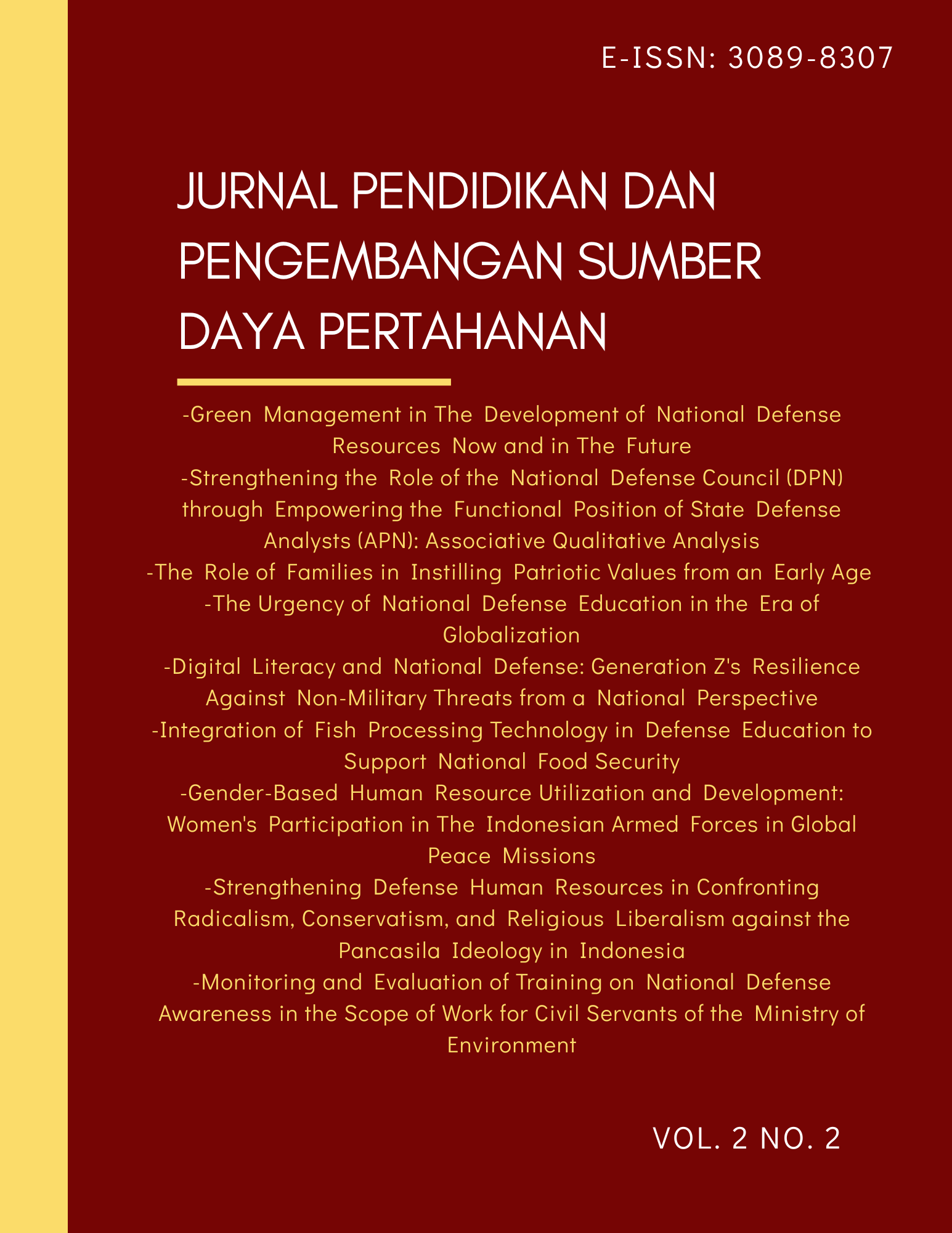
Green Management in The Development of National Defense Resources Now and in The Future
DOI:
https://doi.org/10.63210/jp3.v2i2.160Keywords:
Green Management, Green Human Resource Management, Defense Resources, Sustainability, BPSDM KemhanAbstract
Green Management is a strategic concept emphasizing efficiency, effectiveness, and environmental sustainability through eco-friendly principles. In the context of national defense resource development, applying Green Management is a fundamental urgency. This is because the defense sector involves massive consumption of energy, logistics, and human resources (HR), potentially creating a significant environmental footprint and carbon output. Therefore, Green Management and its core instrument, Green Human Resource Management (GHRM), are essential to establish a new paradigm that balances national security capability with the global mandate for sustainability. The primary objective of this research is to analyze the implementation model of Green Management specifically through GHRM practices in the development of defense HR within institutions like BPSDM Kemhan, identifying challenges and formulating its strategic contributions for the present and the future. This study employs the Systematic Literature Review (SLR) method. The SLR protocol was structured by searching the primary databases Scopus and Web of Science (WoS), targeting publications between 2015–2025. Inclusion criteria focused on empirical and case studies relevant to the
public/military sector. Following the PRISMA selection process, 24 final studies were included and synthesized using thematic content analysis to measure GM implementation effectiveness. The results indicate that Green Management
can be effectively implemented through three pillars: GHRM (showing the highest implementation rate at 70.8%), green organizational strategy, and continuous education. The key benefits of this application are the creation of environmentally conscious defense personnel, significant improvement in operational cost efficiency, reduction of the carbon footprint, and enhancement of institutional image. Implementation alternatives like Green Performance Management and environmental curriculum integration are proposed to address the main constraint found in infrastructure and facilities. Thus, GM and GHRM are crucial not only for internal efficiency but also as a key strategy for developing defense HR that is resilient, professional, and an active contributor to the Sustainable Development Goals (SDGs).
References
Ahmad, S. (2015). Green Human Resource Management: Policies and Practices. Cogent Business & Management, 2(1), 1-13.
Boell, S. K., & Cecez-Kecmanovic, D. (2021). The case for using systematic reviews in research. Journal of Information Technology, 36(2), 177-187.
Boiral, O., & Paillé, P. (2020). Organizational citizenship behaviour for the environment: A systematic literature review and a new conceptual framework. International Journal of Management Reviews, 22(3), 263-282.
Boiral, O., Paillé, P., & Léger, J. (2021). Military Sustainability: A systematic review and a research agenda. Journal of Cleaner Production, 290, 125191.
Crawford, B., et al. (2020). The military's impact on climate change. Environmental Research Letters, 15(12), 124018.
Creswell, J. W., & Creswell, J. D. (2021). Research design: Qualitative, quantitative, and mixed methods approaches. SAGE Publications.
Fagerberg, J., Martin, B. R., & Andersen, E. S. (2012). Innovation studies: A new guide to the field. Oxford University Press.
Freeman, R. E., et al. (2010). Strategic Management: A Stakeholder Approach. Cambridge University Press.
Grant, M. J., & Booth, A. (2019). A typology of reviews: an analysis of 14 review types and associated methodologies. Health Information & Libraries Journal, 36(1), 1–17.
Hart, S. L., & Dowell, G. (2011). A resource-based view of the firm in an environmental context. Strategic Management Journal, 32(11), 1279-1294.
Hasan, M. A., et al. (2022). Sustainable human resource management: a review of the literature and future research agenda. Sustainability, 14(11), 6680.
Khan, S. A., et al. (2021). Green human resource management and employee green behavior: The moderating role of green work environment. Journal of Cleaner Production, 280, 124311.
Paul, J., & Criado, A. R. (2020). The Systematic Literature Review: A systematic literature review on its use in research. Journal of Business Research, 117, 12-25.
Pinzone, M., et al. (2022). Unveiling the role of Green Human Resource Management on employees' green behaviors. Journal of Cleaner Production, 339, 130761.
Renwick, D. W., et al. (2013). Green Human Resource Management: A review, process model, and research agenda. International Journal of Management Reviews, 15(1), 1-22.
Renwick, D. W., et al. (2020). Green Human Resource Management and change management: Linking the two fields. Journal of Cleaner Production, 268, 122194.
Sachs, J. D., Lafortune, G., Kroll, C., Fuller, G., & Woelm, F. (2021). Sustainable development report 2021: The decade of action for the SDGs. Cambridge University Press.
Snyder, H. (2020). Literature review as a research methodology: An overview and guidelines. Journal of Business Research, 104, 333–339.
Yong, J. Y., et al. (2020). The role of green human resource management in achieving sustainable development goals. Journal of Cleaner Production, 268, 122421.
Zhang, Y., et al. (2022). The challenges and opportunities of green supply chain management in the military sector. Defence and Peace Economics, 33(4), 485-502.
Downloads
Published
How to Cite
Issue
Section
License
Copyright (c) 2025 ministry of defense education and training agency

This work is licensed under a Creative Commons Attribution-NonCommercial-ShareAlike 4.0 International License.
All articles published in this journal are licensed under a Creative Commons Attribution 4.0 International License (CC BY 4.0) .
This license allows users to share (copy and redistribute the material in any medium or format) and adapt (remix, transform, and build upon the material) for any purpose, even commercially, provided that appropriate credit is given to the original author(s) and the source.
Copyright of all articles is held by Badan Pendidikan dan Pelatihan Kementerian Pertahanan Republik Indonesia.
For articles published prior to 2026, licensing and copyright information may differ as stated in the article files.




