
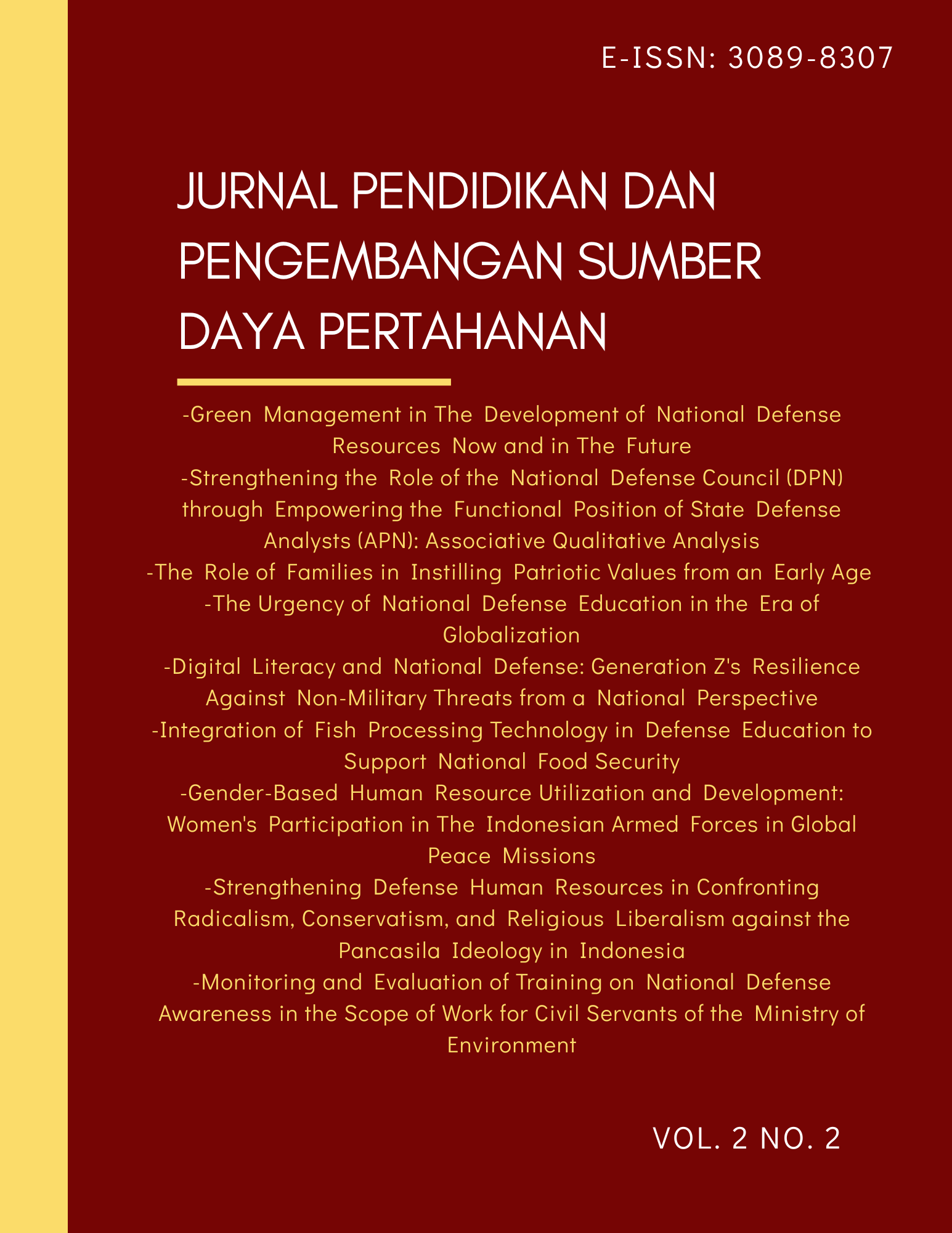
Gender-Based Human Resource Utilization and Development: Women's Participation in The Indonesian Armed Forces in Global Peace Missions
DOI:
https://doi.org/10.63210/jp3.v2i2.164Keywords:
Human Resources Utilization and Development, Gender, Participation of Indonesian Women Military Personnel (TNI), Peacekeeping MissionAbstract
Since the adoption of UN Security Council Resolution 1325 on Women, Peace, and Security, women’s participation in peacekeeping missions has become a strategic issue. In Indonesia, female military personnel represent only 5% to 10% of the force, which is far below the UN target of 15% by 2028. This gap reflects the difference between policy commitments and practical realities, as women’s roles often remain symbolic rather than strategic. This study analyzes the participation of female personnel of the Indonesian National Armed Forces (TNI) in the UNAMID mission and examines the strategies of the Ministry of Defense, Ministry of Foreign Affairs, TNI Headquarters, and the TNI Peacekeeping Mission Center. It identifies supporting and limiting factors and evaluates their relevance to Indonesia’s defense diplomacy and the Sustainable Development Goals (SDGs).Using qualitative methods, the study involves interviews and document analysis, with triangulation to ensure validity. Findings show that female TNI personnel contribute significantly in health services, psychosocial support, and community engagement. Their participation goes beyond quotas and represents a strategic factor in the effectiveness of peace operations and Indonesia’s defense diplomacy. Academically, this research enriches the study of international relations and defense by incorporating gender perspectives as a critical dimension of global security. It highlights the need to internalize gender equality values within military culture through education, public awareness, and policy advocacy, while expanding gender-based peace diplomacy in international forums to enhance global legitimacy.
References
Banwell, S. (2020). Gender and Violence(s) of War and Armed Conflict: More Dangerous to Be Woman? 1st ed. Bingley: Emerald Publishing Limited.
Cockett, R. (2010). Sudan : Darfur and The Failure of an African State. London: Yale University Press.
Hadiwinata, B. S. (2017). Peacekeeping and Indonesia’s Foreign Policy: The Role of the Military and Women Peacekeepers. Jakarta: CSIS.
Hagan, J., dan Richmond, W. (2009). Darfur and the Crime of Genocide. New York: Cambridge University Press.
Kementerian Pertahanan RI. (2015). Modul Bela Negara. Jakarta: Kemhan RI.
Kementerian Pertahanan RI (2017). Pedoman Nilai-Nilai Dasar Bela Negara. Jakarta: Kemhan RI.
Lahdili, N. (2016). “Darfur Conflict: The Role of International Intervention in the Conflict Resolution.” In 5th International Conference on Social Thought and Theory in the MENA Region. Turkey: Sakarya University.
Lemhannas RI. (2019). Bela Negara dalam Perspektif Ketahanan Nasional. Jakarta: Lemhannas.
Mardikanto, T., dan Poerwoko, S. (2013). Pemberdayaan Masyarakat Dalam Perspektif Kebijakan Publik. 2nd ed. Bandung: Alfabeta.
Olsson, L., & Gizelis, T. (2015). Gender, Peace and Security: Implementing UN Security Council Resolution 1325. London: Routledge.
Soetjipto, Ani, dan Trimayuni, P. (2013). Gender & Hubungan Internasional. Yogyakarta: Jalasutra.
Sukma, R. (2012). Indonesia and International Peacekeeping: History, Issues, and Prospects. Jakarta: Centre for Strategic and International Studies (CSIS).
Suliman, O. S. (2011). The Darfur Conflict: Geography or Institutions? New York: Routledge.
Syamsunasir et al. (2022). Keamanan Nasional. 1st ed. Yogyakarta: DEEPUBLISH.
Undang-Undang Dasar Negara Republik Indonesia Tahun 1945.
UNDP. (2019). Sustainable Development Goals Report 2019. New York: United Nations Development Programme.
United Nations. (2000). United Nations Security Council Resolution 1325 on Women, Peace and Security. New York: United Nations.
UN Women. (2021). Women in Peacekeeping: The Power to Build Peace. New York: United Nations.
Cohen, John. M. dan Uphoff, N. T. (1980). “Participation’s Place in Rural Development: Seeking Clarity through Specificity.” World Development 8(3).
Deldiya. (2017). “Motivasi PBB Membentuk United Nation Mission In Darfur (UNAMID) Sebagai Peacekeeping Operation PBB Pada Konflik Sudan 2007.” JOM FISIP 4(2).
Firohmatillah, Z. P., dan Arfin, S. (2019). “Peran Korps Wanita TNI Sebagai Pasukan Pemeliharaan Perdamaian PBB Dalam Humanitarian Assistance Di Lebanon.” Indonesian Perspective 4(2).
Subagyo, A. (2020). “Strategi Indonesia dalam Peningkatan Partisipasi Pasukan Perdamaian Dunia: Perspektif Gender.” Jurnal Pertahanan & Bela Negara, 10(2).
Direktorat Keamanan Internasional dan Pelucutan Senjata. (2023). “Wawancara Direktorat Keamanan Internasional Dan Pelucutan Senjata.”
Direktorat Kerja sama Multilateral. (2023). “Wawancara Direktorat Kerja sama Multilateral.”
Evi. (2023). “Wawancara Serka (K) Evi .”
Irmawati. (2023). “Wawancara Letda CKM (K) Irmawati.”
Napitupulu, Marihot. (2023). “Wawancara Kolonel (KH) Marihot Napitupulu.”
Netty. (2023). “Wawancara Peltu (K) Netty.”
Ops PMPP TNI. (2023). Rekap Data Personel TNI UNAMID 2015-2018. Bogor.
UNAMID. (2017). “UNAMID Force Officials Bi-Annual Magazine.” United Nations, December.
UN Peacekeeping. (2024). Troop and Police Contributors. Diakses pada 27 September 2025 [https://peacekeeping.un.org].
Downloads
Published
How to Cite
Issue
Section
License
Copyright (c) 2025 ministry of defense education and training agency

This work is licensed under a Creative Commons Attribution-NonCommercial-ShareAlike 4.0 International License.
All articles published in this journal are licensed under a Creative Commons Attribution 4.0 International License (CC BY 4.0) .
This license allows users to share (copy and redistribute the material in any medium or format) and adapt (remix, transform, and build upon the material) for any purpose, even commercially, provided that appropriate credit is given to the original author(s) and the source.
Copyright of all articles is held by Badan Pendidikan dan Pelatihan Kementerian Pertahanan Republik Indonesia.
For articles published prior to 2026, licensing and copyright information may differ as stated in the article files.




