
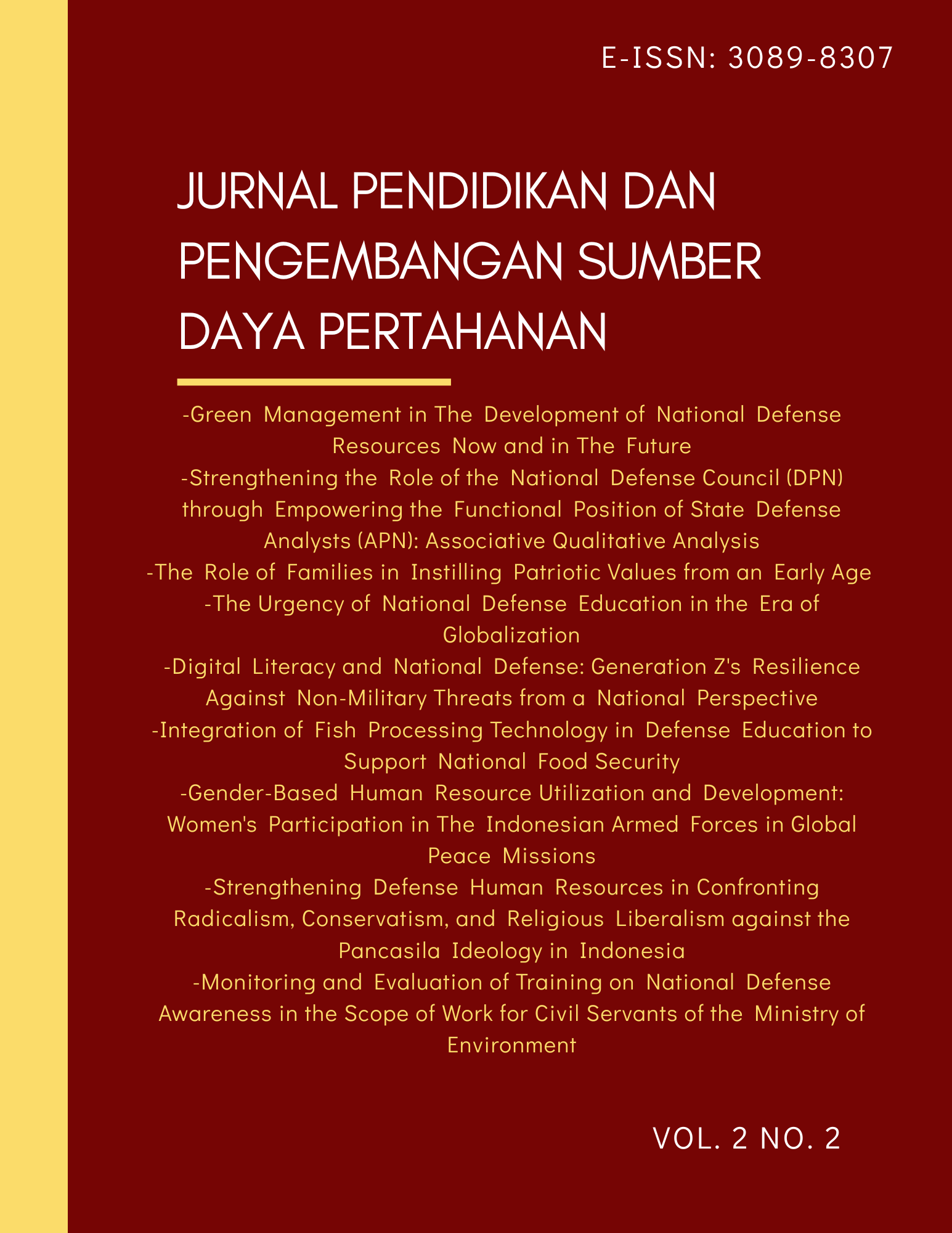
Strengthening Defense Human Resources in Confronting Radicalism, Conservatism, and Religious Liberalism against the Pancasila Ideology in Indonesia
DOI:
https://doi.org/10.63210/jp3.v2i2.188Keywords:
Defense Human Resources, Religious Radicalism, Religious Conservatism, Religious Liberalism, PancasilaAbstract
Non-military threats to Indonesia’s national defense are increasingly complex, as the growth of radicalism, conservatism, and religious liberalism has the potential to weaken social cohesion and erode Pancasila as the state ideology. These three spectrums of ideological threats operate through religious narratives, digital spaces, social networks, and political dynamics, thus demanding a defense response that is not only coercive but also ideological and cultural. This study aims to analyze the characteristics of religious-based ideological threats to Pancasila and formulate strategies for strengthening defense human resources (HR) in maintaining national ideological resilience. This study uses a qualitative approach, drawing on national defense regulations, counter-radicalization policies, official government documents, and academic literature, including books and articles from relevant national and international scholarly journals. The results show that religious radicalism encourages exclusivism and the legitimacy of violence, and religious conservatism breeds rigidity and resistance to national values. In contrast, religious liberalism has the potential to relativize collective values and weaken ideological consensus. In this context, defense human resources play a strategic role as an ideological vanguard through a combination of hard and soft power approaches, including ideological education, digital literacy, counter-narratives, and collaboration with civil society. This research contributes theoretically by offering a conceptual model to strengthen defense human resources in upholding Pancasila, and practically by providing policy recommendations to enhance ideology-based non-military defense in Indonesia.
References
Adhayanto, O., Nazaki, N., Rahmawati, N., Haryanti, D., Suwardi, N., & Pambudi, R. (2021). The Strategy of Strengthening Pancasila Ideology In The Digital Age. Pancasila and Law Review, 2(2), 99–108. https://doi.org/10.25041/plr.v2i2.2396
Aryani, S. A., Wiranto, E. B., Asroni, A., Waston, Fauziyah, S., & Yusup, M. (2024). Synergy of the Ministry of Religious Affairs, Nahdlatul Ulama, and Muhammadiyah in Driving Religious Moderation to Achieve Indonesia’s SDGs Targets. Profetika: Jurnal Studi Islam, 25(02), 433–454. https://doi.org/10.23917/profetika.v25i02.8536
Azra, A. (2016). Transformasi Politik Islam: Radikalisme, Khilafatisme, dan Demokrasi. Kencana.
Booth, K. (2007). Theory of World Security. Cambridge University Press. https://doi.org/10.1017/CBO9780511840210
Bourchier, D. M. (2019). Two Decades of Ideological Contestation in Indonesia: From Democratic Cosmopolitanism to Religious Nationalism. Journal of Contemporary Asia, 49(5), 713–733. https://doi.org/10.1080/00472336.2019.1590620
Bruinessen, M. van. (2013). Introduction: Contemporary Developments in Indonesian Islam and the “Conservative Turn” of the Early Twenty-first Century. In M. van Bruinessen (Ed.), Contemporary Developments in Indonesian Islam: Explaining the “Conservative Turn.” Institute of Southeast Asian Studies.
Burhani, A. N. (2018). Pluralism, Liberalism, and Islamism: Religious Outlook of Muhammadiyah. Studia Islamika, 25(3), 433–470. https://doi.org/10.15408/sdi.v25i3.7765
Carothers, T., & O’Donohue, A. (2019). Democracies Divided: The Global Challenge of Political Polarization. Brookings Institution Press.
Chalmers, I. (2017). Countering Violent Extremism in Indonesia: Bringing Back the Jihadists. Asian Studies Review, 41(3), 331–351. https://doi.org/10.1080/10357823.2017.1323848
Croissant, A., & Lorenz, P. (2018). Comparative Politics of Southeast Asia: An Introduction to Governments and Political Regimes. Springer.
Defence White Paper (Third edition). (2015). Defence Ministry of the Republic of Indonesia.
El-Said, H. (2015). Singapore: Crisis of Identity, Shared Values, And Religious Rehabilitation. In New Approaches to Countering Terrorism: Designing and Evaluating Counter Radicalization and De-Radicalization Programs (pp. 138–173). Palgrave Macmillan. https://doi.org/10.1057/9781137449979_6
Emmers, R. (2004). Non-traditional Security in the Asia-Pacific: The Dynamics of Securitisation. Eastern Universities Press.
Eugene, T. K. B. (2020). Defeating the Scourge of Terrorism: How Soft Law Instruments in Singapore Can Develop Societal Trust and Promote Cooperative Norms. Interreligious Relations, 20, 1–22. https://ink.library.smu.edu.sg/sol_research/3467
Fitri, A. B. M., Barizi, A., Izzuddin, A., Miftahuddin, A. H., & Huda, A. (2025). The Politics and Practice of Religious Moderation in Indonesia: A Study of the Ministry of Religious Affairs, Nahdlatul Ulama, and Muhammadiyah. Islamica: Jurnal Studi Keislaman, 19(2), 321–347. https://doi.org/10.15642/islamica.2025.19.2.321-347
Fitriasari, S., Masyitoh, I. S., & Baeihaqi. (2020). The Role of Pancasila Education Teachers and Citizenship in Strengthening Character Education Based on Pancasila Values. 534–540. https://doi.org/10.2991/assehr.k.200320.101
Floridi, L. (2013). The Ethics of Information. Oxford University Press.
Hamayotsu, K. (2013). The Limits of Civil Society in Democratic Indonesia: Media Freedom and Religious Intolerance. Journal of Contemporary Asia, 43(4), 658–677. https://doi.org/10.1080/00472336.2013.780471
Hasan, N. (2006). Laskar Jihad: Islam, Militancy, and the Quest for Identity in Post-New Order Indonesia. SEAP Publications.
Hasan, N. (2010). The Failure of the Wahhabi Campaign: Transnational Islam and the Salafi Madrasa in Post-9/11 Indonesia. South East Asia Research, 18(4), 675–705. https://doi.org/10.5367/sear.2010.0015
Huntington, S. P. (1957). The Soldier and the State: The Theory and Politics of Civil–Military Relations. Harvard University Press.
Idris, I. (2018). DERADIKALISASI: Kebijakan, Strategi Dan Program Penanggulangan Terorisme. Penerbit Cahaya Insani.
Jayakumar, S. (2021). Research Note: Singapore’s “Deradicalisation” Model: Revolution – or Evolutions? Journal for Deradicalization, 26, 227–246. https://jd.journals.publicknowledgeproject.org/jd/index.php/jd/article/view/443
Kaelan. (2015). Liberalisasi Ideologi Negara Pancasila. Paradigma.
Kurzman, C., & Kurzman, C. (Eds.). (1998). Liberal Islam and Its Islamic Context. In Liberal Islam: A Source Book. Oxford University Press.
Kusuma, K., Hermanto, D., Rudiawan, B., Amiruddin, M., Sumarna, S., Bhakti, D. C., Saragih, H., Rimbawa, A. D., Novian, Y. C., Deksino, G. R., Sudaryanto, H., Zaini, A., Ikhsanudin, A. H., Affandi, L. A., & Wilopo, W. (2024). Manajemen Bela Negara: Konsep dan Tata Kelola Bela Negara Menuju Indonesia Emas. Indonesia Emas Group.
Laporan Capaian Program dan Kegiatan Badan Pembinaan Ideologi Pancasila Tahun 2024. (2025). Badan Pembinaan Ideologi Pancasila Republik Indonesia. https://bpip.go.id/assets/file/pengumuman/2025/07/03/eNvnDJIH9FBeNzZfF0Vp6PYCmBtvwDXTVaRVgiq2.pdf#page=10.10
Laporan Kinerja Badan Nasional Penanggulangan Terorisme Republik Indonesia Tahun 2024. (2025). Badan Nasional Penanggulangan Terorisme Republik Indonesia. https://ppid.bnpt.go.id/storage/berkas/laporan-kinerja-bnpt-tahun-2024-48DETT.pdf
Latif, Y. (2011). Negara Paripurna: Historisitas, Rasionalitas, Dan Aktualitas Pancasila. Gramedia Pustaka Utama.
Madjid, N. (2019). Islam: Doktrin & Peradaban. Gramedia pustaka utama.
Mignolo, W. D. (2011). The Darker Side of Western Modernity: Global Futures, Decolonial Options. Duke University Press.
Montasari, R. (2024). Introduction. In R. Montasari (Ed.), Cyberspace, Cyberterrorism and the International Security in the Fourth Industrial Revolution: Threats, Assessment and Responses (pp. 1–15). Springer International Publishing. https://doi.org/10.1007/978-3-031-50454-9_1
Pangalila, T., & Fatimah, S. (2023). The Influence of Civic Education Learning and the Pancasila Student Profile Program on Improving Ideological Values Understanding. Jurnal Civics: Media Kajian Kewarganegaraan, 20(2), 359–369. https://doi.org/10.21831/jc.v20i2.61511
Peraturan Badan Nasional Penanggulangan Terorisme No. 5 Tahun 2021 Tentang Tata Cara Koordinasi, Pemantauan, Evaluasi, Dan Pelaporan Pelaksanaan Rencana Aksi Nasional Pencegahan Dan Penanggulangan Ekstremisme Berbasis Kekerasan Yang Mengarah Pada Terorisme Tahun 2020-2024 (2021). https://peraturan.go.id/id/peraturan-bnpt-no-5-tahun-2021
Peraturan Badan Nasional Penanggulangan Terorisme Republik Indonesia No. 1 Tahun 2025 Tentang Kontra Radikalisasi (2025). https://peraturan.go.id/id/peraturan-bnpt-no-1-tahun-2025
Peraturan Menteri Pertahanan Republik Indonesia Nomor 12 Tahun 2021 Tentang Kebijakan Penyelenggaraan Pertahanan Negara Tahun 2020-2024 (2021). https://www.kemhan.go.id/strahan/wp-content/uploads/2022/08/JAKGARA-HANNEG-2020-2024.pdf
Peraturan Menteri Pertahanan Republik Indonesia Nomor 25 Tahun 2014 Tentang Doktrin Pertahanan Negara (2014). https://www.kemhan.go.id/itjen/wp-content/uploads/migrasi/peraturan/252014.pdf
Prakoso, L. Y. (2021). Defense Policy Analysis to Deal with Radicalism and Terrorism in Indonesian Universities (SSRN Scholarly Paper No. 3806504). Social Science Research Network. https://doi.org/10.31014/aior.1991.04.01.265
Qodir, Z. (2025). Conservative Turn and Political Identity: Challenges to Democracy in Indonesia After Presidential Election 2019. Identities, 32(3), 370–387. https://doi.org/10.1080/1070289X.2024.2415220
Rahman, A., & Irayanti, I. (2025). The Pancasila Deliberation Model: A Framework for Fostering Democratic Citizenship in Civic Education. Entita: Jurnal Pendidikan Ilmu Pengetahuan Sosial Dan Ilmu-Ilmu Sosial, 7(1), 41–58. https://doi.org/10.19105/ejpis.v7i1.18530
Saeed, A. (2006). Islamic Thought: An Introduction. Routledge.
Sari, F. F. K., Sukarno, & Murwaningsih, T. (2023). The New Paradigm of Merdeka Curriculum: Implementation of Pancasila Education Subject in Elementary School. International Journal of Elementary Education, 7(1), 79–88. https://doi.org/10.23887/ijee.v7i1.54092
Sarjito, A. (2024). Hoaks, Disinformasi, dan Ketahanan Nasional: Ancaman Teknologi Informasi dalam Masyarakat Digital Indonesia. Journal of Governance and Local Politics (JGLP), 6(2), 175–186. https://doi.org/10.47650/jglp.v6i2.1547
Sarjito, A. (2025). Evaluating Indonesia’s National Defense Policy in Shaping an Effective Area Denial Strategy. Journal of Political Issues, 6(2), 124–134. https://doi.org/10.33019/jpi.v6i2.216
Schmidt, L. (2018). Cyberwarriors and Counterstars: Contesting Religious Radicalism and Violence on Indonesian Social Media. Asiascape: Digital Asia, 5(1–2), 32–67. https://doi.org/10.1163/22142312-12340088
Singh, A. (2024). Hindu-Muslim Conflict in India: Causes, Consequences & Resolution. International Journal of Social Science Research & Review, 7(10), 62–79. https://doi.org/10.47814/ijssrr.v7i10.2273
Sterkens, C., & Hadiwitanto, H. (2016). Empirical Models of the Relationship between Religion and State in Indonesia: How Religious Beliefs Define the Relation between Religion and State. In Freedom of Religion in the 21st Century (pp. 162–206). Brill. https://doi.org/10.1163/9789004304390_009
Subagyo, A. (2015). Syarat-Syarat Kesiapan Penyelenggaraan Program Bela Negara. Jurnal Pertahanan Dan Bela Negara, 5(3), 1–20. https://doi.org/10.33172/jpbh.v5i3.367
Sumpter, C. (2017). Countering violent extremism
Downloads
Published
How to Cite
Issue
Section
License
Copyright (c) 2025 ministry of defense education and training agency

This work is licensed under a Creative Commons Attribution-NonCommercial-ShareAlike 4.0 International License.
All articles published in this journal are licensed under a Creative Commons Attribution 4.0 International License (CC BY 4.0) .
This license allows users to share (copy and redistribute the material in any medium or format) and adapt (remix, transform, and build upon the material) for any purpose, even commercially, provided that appropriate credit is given to the original author(s) and the source.
Copyright of all articles is held by Badan Pendidikan dan Pelatihan Kementerian Pertahanan Republik Indonesia.
For articles published prior to 2026, licensing and copyright information may differ as stated in the article files.




