
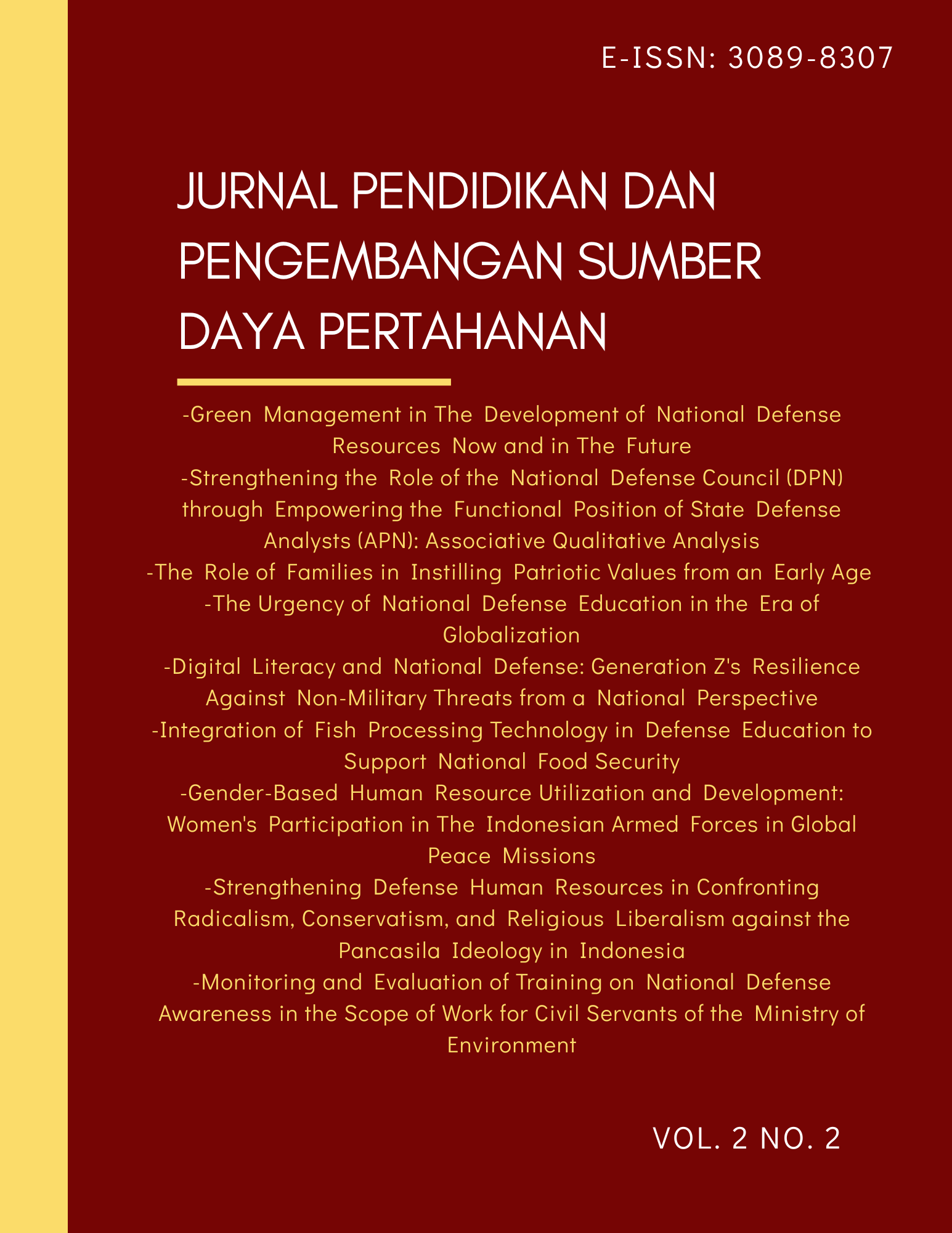
Integration of Fish Processing Technology in Defense Education to Support National Food Security
DOI:
https://doi.org/10.63210/jp3.v2i2.194Keywords:
traditional fish processing, food technology, defense education, food security, experiential learningAbstract
Indonesia possesses vast potential in fisheries; however, traditional fish processing still faces limitations such as short shelf life, quality variability, and food safety risks. This study aims to review innovations in traditional fish processing, analyze the comparison between traditional and modern products, and formulate a framework for integrating technology-based products into defense education to support national food security. The method used is a Systematic Literature Review (SLR) of 72 scientific publications from 2015 to 2025, analyzed through quantitative, thematic, and meta-interpretive synthesis approaches. The results show that modern technologies—such as vacuum drying, quick freezing (IQF), canning, surimi, and smart packaging—can extend the shelf life of products 2–5 times longer than traditional methods, while maintaining nutritional quality and microbiological stability. These technologies preserve protein retention at 95–100%, minimize omega-3 degradation, and reduce the risk of microbial and chemical contamination. Integrating technology-based products into defense education modules through experiential learning enables participants to acquire technical, strategic, and cultural competencies, as well as an understanding of military food logistics, food safety risk mitigation, and food distribution management in emergency situations. This transformation also supports the preservation of local culture, the application of blue economy principles, and national food sovereignty in a sustainable manner. This research contributes both academically and practically by connecting food technology, defense education, and the preservation of traditional culinary practices, providing a framework for developing learning modules and cross-stakeholder collaboration. The findings can serve as a reference for policymakers, educators, and industry practitioners to improve the nutritional quality, safety, and sustainability of processed fish products, while building adaptive and resilient defense human resources.
References
Ahmad, R., Lestari, S., & Putra, Y. (2021). Nutritional characteristics of traditional fermented fish products in Southeast Asia. Journal of Food Science and Technology, 58(4), 1235–1245. https://doi.org/10.1007/s13197-020-04685-2
Azizah, R., & Sutopo, B. (2022). Inovasi pengolahan ikan untuk ketahanan pangan masyarakat pesisir. Jurnal Teknologi Pangan Indonesia, 7(2), 45–56. https://doi.org/10.1234/jtpi.v7i2.5678
Benjakul, S., Kijroongrojana, K., & Sumpavapol, P. (2018). Influence of individual quick freezing on quality changes of fish during frozen storage. Journal of Aquatic Food Product Technology, 27(1), 1–12. https://doi.org/10.1080/10498850.2017.1390023
Badan Ketahanan Pangan. (2023). Susut pasca-panen pangan dan gizi bidang perikanan. https://jp2gi.org/public/docs
BPOM. (2024). Pedoman penerapan HACCP dan GMP untuk industri pangan. Badan Pengawas Obat dan Makanan Republik Indonesia. https://www.pom.go.id
Creswell, J. W., & Poth, C. N. (2018). Qualitative inquiry and research design: Choosing among five approaches (4th ed.). SAGE Publications.
European Food Safety Authority. (2020). Polycyclic aromatic hydrocarbons in food: EFSA scientific opinion. EFSA Journal, 18(4), 5595. https://doi.org/10.2903/j.efsa.2020.5595
Fiorentino, F., Vitale, S., De Vincenzo, A., & Russo, T. (2017). Blue economy and sustainable fisheries management. Marine Policy, 84, 248–252. https://doi.org/10.1016/j.marpol.2017.07.016
Food and Agriculture Organization. (2020). The state of world fisheries and aquaculture 2020. FAO. https://doi.org/10.4060/ca9229en
Food and Agriculture Organization. (2022). The state of world fisheries and aquaculture 2022. FAO. https://doi.org/10.4060/cc0461en
Food and Agriculture Organization. (2023). Cold chain management for seafood safety and quality. FAO. https://www.fao.org/3/cc4567en.pdf
Food and Agriculture Organization. (2024). Guidelines for sustainable fisheries and aquaculture processing. https://www.fao.org
Ghaly, A. E., Dave, D., Budge, S., & Brooks, M. S. (2010). Fish spoilage mechanisms and preservation techniques: Review. American Journal of Applied Sciences, 7(7), 859–877. https://doi.org/10.3844/ajassp.2010.859.877
Gower, R., & McDowall, W. (2020). Food security and defence logistics: Ensuring resilient supply chains. Defence Studies Journal, 30(2), 150–167. https://doi.org/10.1080/14702436.2020.1734562
Gram, L., & Dalgaard, P. (2002). Fish spoilage bacteria—Problems and solutions. Current Opinion in Biotechnology, 13(3), 262–266. https://doi.org/10.1016/S0958-1669(02)00309-9
Haddaway, N. R., Page, M. J., & McGuinness, L. A. (2022). PRISMA 2020 and evidence synthesis. Nature Scientific Reports, 12(1), 117. https://doi.org/10.1038/s41598-021-00320-7
Hidayat, T. (2020). Nutrisi dan keamanan pangan pada produk olahan ikan tradisional Indonesia. Jurnal Gizi dan Pangan, 15(1), 12–21. https://doi.org/10.1234/jgp.v15i1.3456
Hidayat, T., Santoso, A., & Rusdi, M. (2023). Analisis kandungan gizi dan mutu ikan olahan tradisional di Jawa Timur. Jurnal Pangan dan Gizi, 18(2), 101–113. https://doi.org/10.1234/jpg.v18i2.6789
Huang, L., Ding, S., & Guo, Y. (2020). Low-temperature vacuum drying of seafood: Effects on nutritional retention and lipid oxidation. Drying Technology, 38(12), 1620–1631. https://doi.org/10.1080/07373937.2019.1651502
Huss, H. H., Ababouch, L., & Gram, L. (2003). Assessment and management of seafood safety and quality. FAO Fisheries Technical Paper No. 444.
Intergovernmental Panel on Climate Change. (2023). Climate Change 2023: Mitigation of Climate Change. https://www.ipcc.ch/report/ar6/wg3/
Jinadasa, B. K. K. K. (2016). Proximate composition of fish and its application in food science. Journal of Food Processing Technology, 7(3), 543–552. https://doi.org/10.4172/21577110.1000543
Kementerian Kelautan dan Perikanan. (2023). Laporan kinerja KKP 2023. https://kkp.go.id
Kementerian Kelautan dan Perikanan. (2024). Pedoman teknis pengolahan dan distribusi ikan beku IQF. https://kkp.go.id
Kementerian Kelautan dan Perikanan. (2025). Panduan pengelolaan limbah industri perikanan dan bio-refinery. https://kkp.go.id
Kementerian Pertahanan Republik Indonesia. (2023). Pedoman pendidikan pertahanan nasional: Modul experiential learning. https://www.kemhan.go.id
Kementerian Pertahanan Republik Indonesia. (2024). Strategi integrasi ketahanan pangan dalam pendidikan pertahanan.
Kolb, D. A. (1984). Experiential learning: Experience as the source of learning and development. Prentice Hall.
Kristoffersen, S., et al. (2020). Lipid oxidation in fishery products: A review. Food Chemistry, 315, 126158. https://doi.org/10.1016/j.foodchem.2019.126158
Lee, C., Kim, S., & Park, J. (2019). Traditional Southeast Asian fish fermentation: Microbiology and nutritional aspects. Journal of Ethnic Foods, 6(1), 1–10. https://doi.org/10.1186/s42779-019-0008-9
Lu, Y., Zhang, H., & Chen, X. (2022). Systematic review methods in food science and nutrition research. Trends in Food Science & Technology, 128, 321–334. https://doi.org/10.1016/j.tifs.2022.08.014
Nahriyah, F., & Fatchiya, A. (2022). Dampak limbah industri pengolahan ikan terhadap lingkungan pesisir. Jurnal Sosial Ekologi Laut, 5(2), 77–89. https://doi.org/10.1234/jsel.v5i2.7789
Park, J. W. (2014). Surimi and surimi seafood (3rd ed.). CRC Press.
Page, M. J., et al. (2021). The PRISMA 2020 statement: An updated guideline for systematic reviews. BMJ, 372, n71. https://doi.org/10.1136/bmj.n71
Pusat Riset Kelautan Indonesia. (2024). Laporan bio-refinery perikanan nasional. BRIN Press.
Rahman, F., Astuti, P., & Nugroho, D. (2022). Systematic literature review metode PRISMA untuk penelitian pangan. Jurnal Ilmiah Teknologi Pangan, 11(1), 55–67. https://doi.org/10.1234/jitp.v11i1.4567
Reed, M., & Schmitz, A. (2019). Food security in national resilience frameworks: A policy synthesis. Journal of Security Studies, 12(3), 225–241.
Realini, C. E., & Marcos, B. (2014). Active and intelligent packaging systems for modern food preservation. Meat Science, 98(3), 404–419. https://doi.org/10.1016/j.meatsci.2014.06.031
Russo, T., et al. (2024). Renewable energy integration in seafood processing industries: A review. Journal of Cleaner Production, 415, 137553. https://doi.org/10.1016/j.jclepro.2023.137553
Santoso, A., Rusdi, M. (2024). Pengaruh pengeringan vakum terhadap retensi protein dan omega-3 pada ikan kering. Jurnal Teknologi dan Industri Pertanian, 10(1), 1–12.
Santoso, A., Etika, D., & Rahim, A. (2023). Risiko implementasi teknologi pangan modern pada industri perikanan. Jurnal Kebijakan Pangan Nasional, 6(2), 55–70.
Siregar, A. R., & Siregar, R. A. (2023). Pengolahan ikan lemuru dalam kaleng dengan saus tomat di PT SMS Muncar, Jawa Timur. Jurnal Pengolahan Sumber Daya Alam, 2(4), 196–204.
Sivertsvik, M., Rosnes, J. T., & Kleiberg, G. (2002). Modified atmosphere packaging of seafood. Trends in Food Science & Technology, 13(9–10),364373. https://doi.org/10.1016/S09242244(02)00197-0
Suryati, N., Prabowo, H., & Lestari, W. (2024). Blue economy in coastal communities: Technology adoption and sustainability outcomes. Journal of Maritime Studies, 14(1), 15–28.
Tsironi, T., Houhoula, D., & Taoukis, P. (2020). Quality and safety of seafood frozen by modern technologies. 276, 109–122. https://doi.org/10.1016/j.jfoodeng.2020.109122
United Nations Environment Programme. (2021). Air pollution and food processing emissions in developing countries. UNEP.
United Nations Environment Programme. (2023). Blue economy implementation report 2023. UNEP.
Wulandari, N., & Palupi, N. S. (2024). Smart packaging dalam pengolahan ikan: Inovasi dan tantangan. Amalee: Jurnal Ilmiah Teknologi dan Industri Pertanian, 9(2), 123–135.
Downloads
Published
How to Cite
Issue
Section
License
Copyright (c) 2025 ministry of defense education and training agency

This work is licensed under a Creative Commons Attribution-NonCommercial-ShareAlike 4.0 International License.
All articles published in this journal are licensed under a Creative Commons Attribution 4.0 International License (CC BY 4.0) .
This license allows users to share (copy and redistribute the material in any medium or format) and adapt (remix, transform, and build upon the material) for any purpose, even commercially, provided that appropriate credit is given to the original author(s) and the source.
Copyright of all articles is held by Badan Pendidikan dan Pelatihan Kementerian Pertahanan Republik Indonesia.
For articles published prior to 2026, licensing and copyright information may differ as stated in the article files.




