
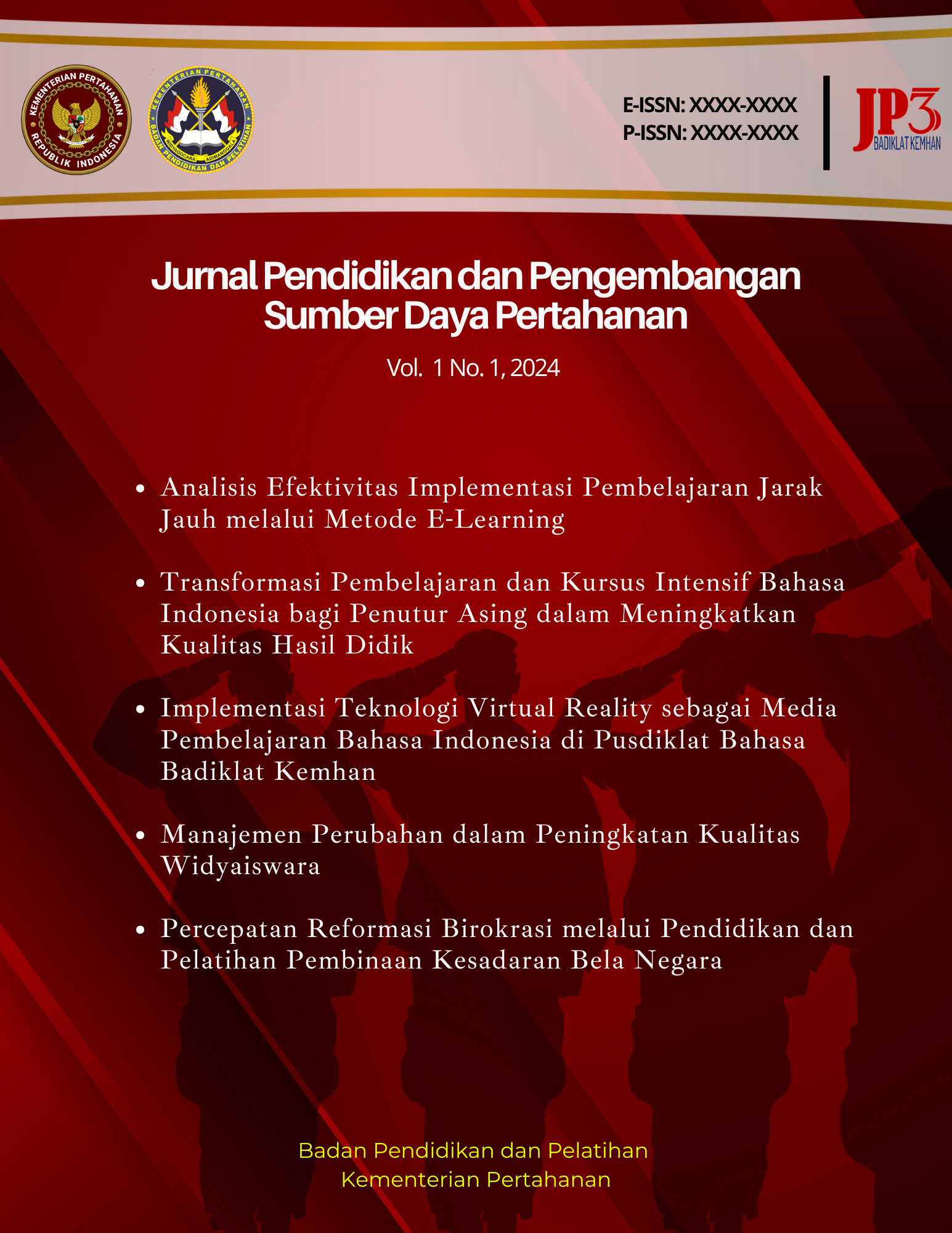
Analysis of The Effectiveness of Implementing Distance Learning through E-learning Methods
DOI:
https://doi.org/10.63210/jp3.v1i1.6Keywords:
e-Learning, distance learning, learning mediaAbstract
Distance learning through the e-learning method is a learning process that is carried out online or digitally. This needs to be applied/implemented at the Defense Functional Technical Education and Training Center of the Ministry of Defense's Badiklat because of the demands of technological and information developments since the onset of Covid 19. The aim of this research is to understand the extent of the effectiveness of long-distance training using the e-Learning method at the Defense Functional Technical Training Center of the Ministry of Defense's Badiklat . The method used is descriptive qualitative, namely a case study approach which is intended to describe the perceptions of organizers and participants regarding the application of e-Learning learning methods in Group III Transfer Technical Training and Kindergarten General Administration Technical Training. III which was held in 2020. From the results of the analysis it was concluded that the interactivity aspect between Widyaiswara and the participants, both synchronously and asynchronously, had not taken place effectively. As for the aspect of independence in learning, in general the participants were quite enthusiastic and able to carry out learning activities independently. Furthermore, the accessibility aspect of e-Learning applications in general, both Widyaiswara and participants can access them well. Likewise, from the enrichment aspect, in general enrichment learning materials are quite good, such as providing presentation slides for training materials and teaching materials. As for video streaming, video tutorials, simulations and animations, they cannot yet be implemented, because the features in the e-Learning application are still limited. The results of this research show that most of the recommendations and suggestions are the need for additional features in e-Learning applications such as video conferencing, video streaming or video tutorials and other features to support the quality of interaction. Apart from that, there is also a need to increase the capacity of Widyaiswara regarding the use and utilization of information technology in the field of online/digital learning. And it is necessary to accelerate in supporting digitalization transformation in the field of education and training.
References
Atmodiwirio, S (2005). Manajemen Pelatihan.Jakarta: Ardadizya Jaya.
Chandrawati, Sri Rahayu. 2010. “Pemanfaatan e-Learning dalam pembelajaran”. Vol. 8. No 2. Dinas Pendidikan Kabupaten Ketapang, Kalimantan Barat.
Clark, R.C. & Mayer, R.E. (2008). E-learning and the science of instruction: proven guidelines for consumers and designers of multimedia learning, second edition. San Francisco: John Wiley & Sons, Inc.
Dessler Gary, 2009. Manajemen Sumber Daya Manusia. Jakarta: Index
Devi, R & Shaik N (2012). Evaluating training & development effectiveness – A Measurement Research.2 (1),7220
Hanum, Numiek Sulistyo. 2013. “Keefektifan E-Learning Sebagai Media Pembelajaran (Studi Evaluasi Model Pembelajaran E-Learning Smk Telkom Sandhy Putra Purwokerto)”. Jurnal Pendidikan Vokasi. Vol. 3 No. 1. Program Studi Pendidikan Teknologi dan Kejuruan PPs UNY.
Lantip Diat Prasojo & Riyanto. (2011). Teknologi informasi pendidikan. Yogyakarta: Gava Media.
Munir. (2009). Pembelajaran jarak jauh berbasis teknologi informasi dan komunikasi. Bandung: Alfabeta.
Rusman, dkk. (2011). Pembelajaran berbasis teknologi informasi dan komunikasi, mengembangkan profesionalitas guru. Jakarta: PT. Raja Grafindo.
Rusman.(2012). Model –Model Pembelajaran. Depok : PT Rajagrafindo Persada.
Rahmadi, Muhammad Harry. 2017. “Menumbuhkan Inovasi Kediklatan”, dari http://samarinda.lan.go.id di akses tanggal 14 Agustus 2020
Seok, Soonhwa. (2008). The aspect of elearning. International Journal on ELearning, Proquest, 7(4), 725-741.
Sanaky AH, Hujair (2009). Media Pembelajaran. Yogyakarta: Safiria Insania Press.
Yazdi, Mohammad. 2012. “E-Learning Sebagai Media Pembelajaran Interaktif Berbasis Teknologi Informasi”. Jurnal ilmiah foristek. Vol.2 No.1. Fakultas Matematika dan Ilmu Pengetahuan Alam, Universitas Tadulako
Undang-undang Nomor 5 Tahun 2014 tentang Aparatur Sipil Negara (ASN)
Peraturan Pemerintah Nomor : 101 Tahun 2000 tentang Pendidikan dan Pelatihan Jabatan Pegawai Negeri Sipil.
Peraturan Pemerintah Nomor 17 Tahun 2020 tentang Perubahan atas Peraturan Pemerintah Nomor 11 Tahun 2017, tentang Manajemen PNS
Peraturan Menteri Pertahanan RI Nomor : 14 Tahun 2019 tentang Susunan Organisasi dan Tata Kerja Kementerian Pertahanan
Downloads
Published
How to Cite
Issue
Section
License
Copyright (c) 2024 ministry of defense education and training agency

This work is licensed under a Creative Commons Attribution-NonCommercial-ShareAlike 4.0 International License.
All articles published in this journal are licensed under a Creative Commons Attribution 4.0 International License (CC BY 4.0) .
This license allows users to share (copy and redistribute the material in any medium or format) and adapt (remix, transform, and build upon the material) for any purpose, even commercially, provided that appropriate credit is given to the original author(s) and the source.
Copyright of all articles is held by Badan Pendidikan dan Pelatihan Kementerian Pertahanan Republik Indonesia.
For articles published prior to 2026, licensing and copyright information may differ as stated in the article files.




